China has pursued a path that seeks harmony between development and nature, and is joining countries worldwide in a pursuit of a greener future for all.
BEIJING, June 5 (Xinhua) -- With the campaign message "Now for Climate," this year's World Environment Day calls for urgent action as the planet's warning signs grow harder to ignore.
From scorching temperatures and raging wildfires to severe floods and droughts, extreme weather events are unfolding with growing frequency, posing a shared challenge to humanity's future.
Amid these challenges, China has pursued a path that seeks harmony between development and nature, and is joining countries worldwide in a pursuit of a greener future for all.
GREEN DEVELOPMENT IN ACTION
The "two mountains" concept, which holds that "lucid waters and lush mountains are invaluable assets," has served as a guiding principle of China's environmental governance. First articulated by Chinese President Xi Jinping in Anji County in 2005 when he was then Party chief of Zhejiang Province, it holds that ecological conservation and economic development can go hand in hand, creating mutually reinforcing benefits.
Across the country, this vision has been translated into policies, projects and local practices.
At the headwaters of the Yangtze River, the Yellow River and the Lancang River lies the Sanjiangyuan region, often referred to as China's "water tower."
Since the establishment of Sanjiangyuan National Park in 2021, local authorities have sought to balance ecological conservation with community development. Through an innovative stewardship program, nearly 20,000 herders have been employed as ecological rangers, earning annual government subsidies while contributing to the protection of the region's grasslands, wetlands and wildlife.
Stretching more than 6,300 km, the Yangtze River supports over 40 percent of China's population and serves as a vital economic artery. To restore its ecological health, China launched a 10-year fishing ban across key waters of the Yangtze basin in 2021, alongside broader efforts to curb pollution and rehabilitate river ecosystems.
Nature is beginning to respond. Along sections of the Yangtze River where ecological restoration efforts have taken effect, sightings of the Yangtze finless porpoise -- affectionately known as the "smiling angel" -- have become more common, alongside a gradual recovery of native fish species.
This reflects China's broader approach to green development: ecological conservation and economic progress are not competing goals, but mutually reinforcing ones.
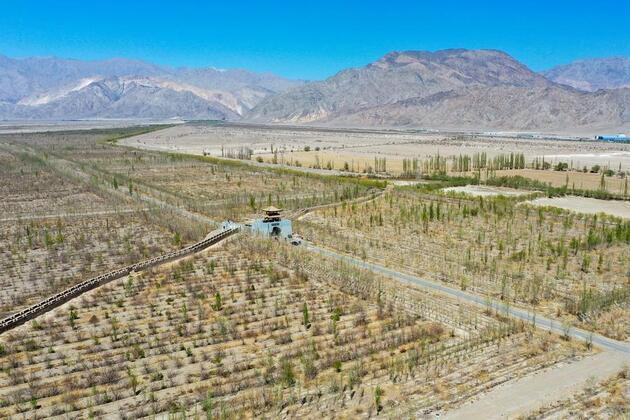
Since 1978, China's Three-North Shelterbelt Forest Program has rehabilitated vast stretches of desertified land in the country's arid north. By the end of 2025, the restored area had reached 336,000 square km, roughly the size of Germany.
Its influence now extends far beyond China. Experience gained from the program has helped inform restoration efforts in other regions, including Africa's Great Green Wall Initiative along the southern edge of the Sahara Desert.
Earlier this year, China adopted the landmark Ecological and Environmental Code, providing a comprehensive legal framework for ecological conservation and environmental protection.
Fuad Gani, vice director of the Graduate School of Sustainable Development at the University of Indonesia, said that China's ecological civilization philosophy stands out for its ability to translate environmental goals into long-term policies and governance frameworks. "It is one of China's most valuable contributions to advancing green transformation on the global stage," he said.
STEERING GREEN DEVELOPMENT TOGETHER
In Uzbekistan's Navoi region, rows of wind turbines now rise from the dry, open landscape near Zarafshan, harnessing Central Asia's powerful winds to generate clean electricity for homes and businesses.
For many countries rich in renewable resources, the challenge of climate action is often not a lack of ambition, but a lack of access to finance, affordable technology and practical expertise, Mohamed Adow, director of Power Shift Africa, a Nairobi-based think tank driving climate action across Africa, told Xinhua.
Chinese technology, manufacturing capacity and engineering experience are helping to make that access more attainable.
Built by PowerChina and equipped with Chinese-made wind turbines, the Zarafshan Wind Power Project has become a landmark of China's green cooperation with Central Asia. The 521.7-megawatt facility can provide electricity for around 500,000 households and cut carbon emissions by roughly 1.1 million tonnes annually.
The project reflects a wider trend. From wind turbines and solar panels to electric vehicles, Chinese green products have reached more than 200 countries and regions, helping make low-carbon technologies more affordable and accessible for countries seeking to decarbonize.
Lower technology costs make climate action more achievable and economically attractive, Adow said.
But climate action is not measured solely by installed capacity or emissions reductions. Its ultimate test is whether the green transition can improve people's lives.
Surat Bualert, an associate professor at Kasetsart University in Thailand, said people facing basic livelihood pressures need development pathways in which environmental progress and welfare improvements advance together.
China's green cooperation therefore extends beyond large infrastructure projects to smaller, locally adapted initiatives that address everyday needs.
In Uganda, China launched the first Clean Stove flagship project in May 2026, pledging to provide 14,000 high-efficiency biomass cookstoves and jointly build a clean-stove demonstration village.
In Nauru, nearly 500 solar-powered streetlights provided by China have improved road safety and daily life on the island.
Delivering projects, however, is only part of the answer. A green transition that depends permanently on external assistance is not sustainable.
Through training, technology sharing and capacity building, China has also worked to help partner countries strengthen their own ability to pursue low-carbon development.
The De Aar Wind Power Project in South Africa offers a compelling example. As the first wind energy project in Africa developed, built and operated by a Chinese power company, it has generated more than 700 local jobs, trained over 110 young technicians, and fostered a workforce in which local employees now make up more than 80 percent of the staff.
A SHARED GREENER FUTURE
As the world marks World Environment Day 2026, the call for urgent climate action carries renewed weight. With global temperatures edging closer to critical thresholds, questions are emerging over whether concrete measures can stay on track amid political uncertainty and rising trade frictions.
The pressure is already visible. The United States has withdrawn from the Paris Agreement and revoked its international climate finance commitments. In Europe, the green agenda has not disappeared, but implementation has slowed amid efforts to simplify sustainability rules and delay interim climate targets.
"Trust is the foundation of international climate cooperation," Adow told Xinhua. When funding commitments are delayed or reduced and policy signals fluctuate, confidence can be eroded. Many developing countries are willing to pursue ambitious climate action, but they need assurance that international partners will honor their commitments.
Against this backdrop, policy continuity itself becomes a form of climate contribution.
For Fuad Gani, the Indonesian scholar, China's long-term planning and steady commitment to green development are helping to bolster confidence in global climate cooperation.
While delivering video remarks at the UN Climate Summit in September 2025, Xi noted that "green and low-carbon transition is the trend of our time," calling on the international community to stay focused on the right direction.
At the summit, China unveiled its updated Nationally Determined Contributions, pledging deeper emissions cuts and an accelerated energy transition by 2035.
Shouldering its own responsibility, China continues to uphold the principle of common but differentiated responsibilities, maintaining that the green transition should serve to narrow, rather than widen, the North-South gap.
"In view of developed countries having the largest share of historical and present-day emissions, they were to lead on mitigating greenhouse gas emissions and on supporting adaptation in vulnerable countries, including providing financial assistance with 'new and additional' monies," Mizan Khan, deputy director of the International Centre for Climate Change and Development, and his co-authors wrote in a study on climate justice.
As countries see tangible development benefits from climate action, the global transition will be faster, fairer, and more durable, Adow added.
Keeping the transition fair also requires keeping it open. China called for stronger international coordination in green technologies and industries to address the shortfall in green production capacity and ensure the free flow of quality green products globally so that the benefits of green development can reach all corners of the world.
Offering a comprehensive vision, China's green transformation experience can serve as an important reference for many countries seeking to make the Earth a more sustainable and comfortable place for future generations, said Gani.



 Share
Share
 Tweet
Tweet
 Share
Share
 Flip
Flip
 Email
Email